


Why This Article Matters
Trust is the most invoked and least precisely defined word in banking AI leadership. This article changes that. It presents the Four-Layer Trust Architecture – Data Trust, Model Trust, System Trust, Outcome Trust – as a named, citable, proprietary intellectual framework with a precise engineering definition, a cascade failure mechanism that explains why most AI estates are more fragile than they appear, and a closing definition that a CIO can put in a board deck or a regulatory response. If you walk away with one framework from this entire series, make it this one.
Trust Is a System, Not a Property
A model that is highly accurate but trained on inconsistently governed data is not a trusted model. It is an accurate model with an unreliable foundation that has not yet been stress-tested under the conditions that will expose it.
A governance framework that reviews models thoroughly before deployment but has no continuous monitoring after deployment is not a trust infrastructure. It is a gate that opens once and never closes again.
Trust in AI-first banking exists – genuinely, defensibly, at production scale – only when four interconnected layers function together as a system. Each layer is necessary. None is sufficient on its own. And a failure in any one propagates to the others in a direction and at a speed that is predictable, if you understand how the system is constructed.
The Four-Layer Trust Architecture
Layer 1: Data Trust – The Foundation Every Other Layer Depends On
Every AI decision begins with data. If that data is inconsistent, incomplete, stale, or siloed – the downstream consequences are not limited to the data layer. They propagate immediately into the model layer, the decision layer, and the regulatory layer.
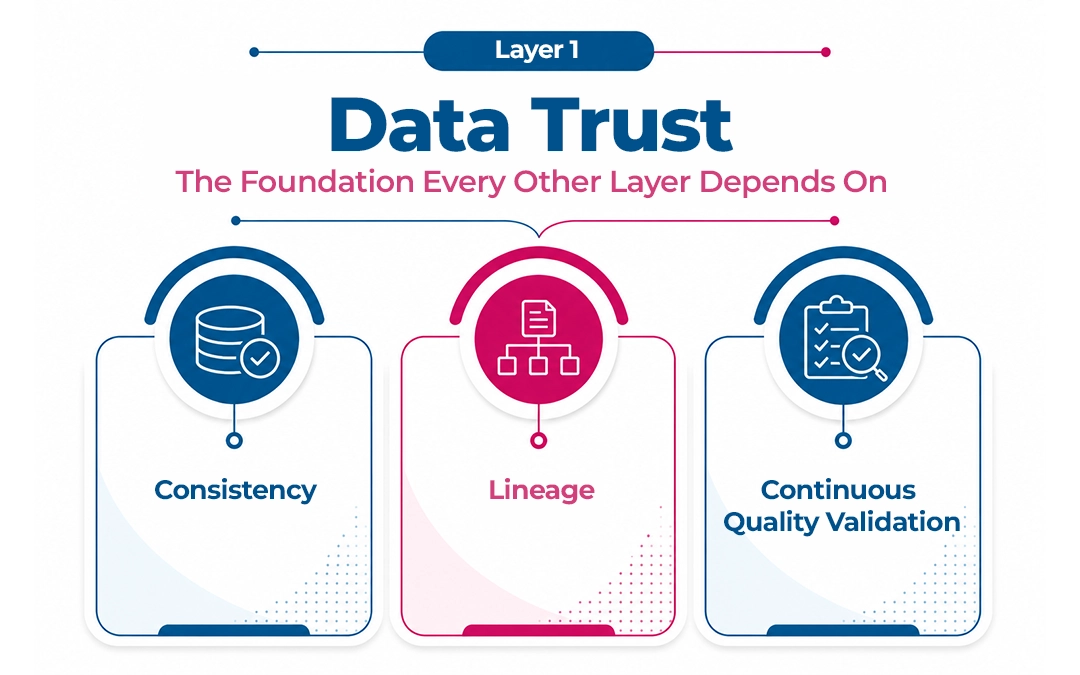
Data trust requires three things:
- Consistency: – the same customer, the same account, the same transaction must be represented consistently across every system that any AI model consuming that data will reference. Not approximately consistently. Consistently, in real time.
- Lineage: – every data point that influences an AI decision must be traceable to its origin: where it came from, when it was created, how it has been transformed. This is the mechanism by which an institution can reconstruct the exact data state that produced a specific decision – which is precisely what a regulatory examination requires.
- Continuous quality validation: – data quality is not a state that is achieved and then maintained passively. It degrades. The data contract – a defined, monitored, enforced specification of what every model in production expects from its inputs – is the mechanism that makes data trust operational.
Failure Mode
Siloed data across banking systems model trained on incomplete or inconsistent signals incorrect decisions in credit scoring, fraud detection, or personalisation regulatory exposure and forced remediation that costs a multiple of what data governance would have required.
Layer 2: Model Trust – From Accuracy to Accountability
Model accuracy is a necessary condition for model trust. It is not a sufficient one. A model that achieves 96% accuracy in testing and cannot explain why it made a specific decision for a specific customer is not a trusted model. It is an accurate model with an accountability deficit.
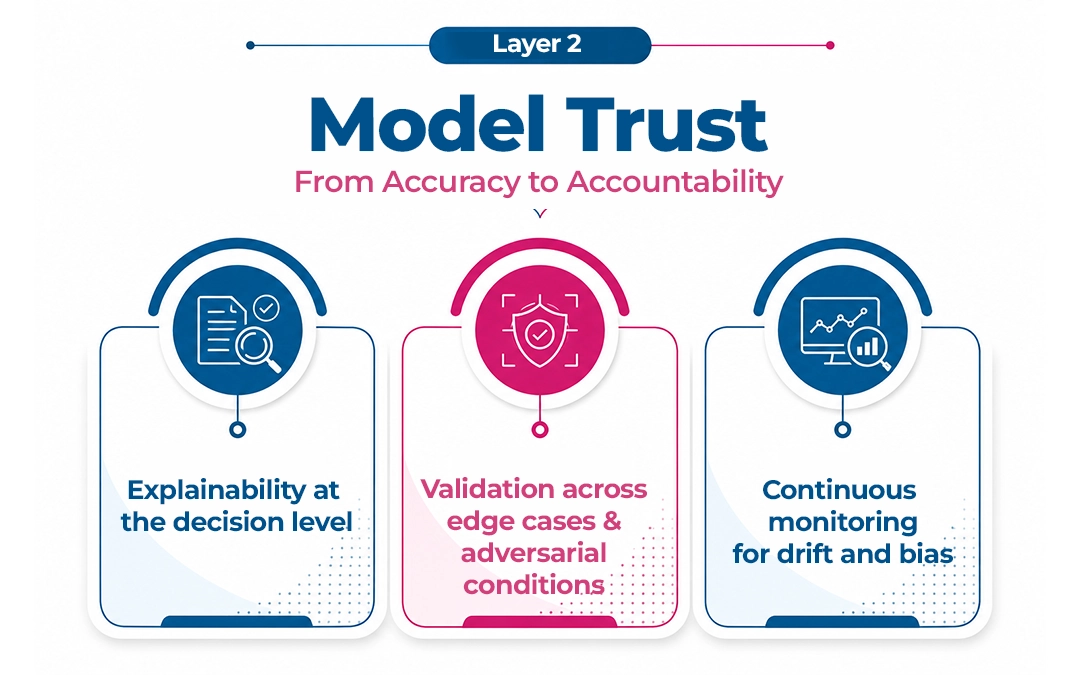
Model trust requires:
- Explainability at the decision level: – not ‘we can describe how the model works in general,’ but ‘we can reconstruct, specifically and coherently, why this model produced this output for this input at this moment.’
- Validation across edge cases and adversarial conditions: – production is not a favourable condition. Edge case validation tests model behaviour at the margins of its training distribution, under data conditions it has not seen.
- Continuous monitoring for drift and bias: – a model validated at deployment was trusted on one day, under the conditions that existed on that day. Models drift as the world they were trained to represent changes.
Failure Mode
High-performing but opaque or unmonitored models inability to explain specific decisions under challenge regulatory audit failures and adverse action violations forced model rollbacks, consent orders, sustained erosion of regulator confidence.
Layer 3: System Trust – Predictability at Enterprise Scale
A model does not operate in isolation. It operates within a system – data pipelines, integration layers, deployment infrastructure, downstream decisioning workflows, and the other models and systems it interacts with. System trust governs how all of these components behave together.
The failure mode that system trust prevents is not visible at the component level. Individual components can each pass their respective validation gates and still combine to produce system-level failures that none of them individually predicted. This is the nature of complex system failure: it lives in the interactions, not the components.
System trust requires: behavioural predictability across environments, integration stability under change, and continuous validation embedded in the delivery pipeline – the shift from periodic testing to always-on quality intelligence.
Failure Mode
Frequent releases without system-level validation defects propagating across interconnected AI and banking systems failures in customer transactions, credit decisions, or fraud workflows loss of internal confidence in the delivery pipeline.
Layer 4: Outcome Trust – Reliability the Business Can Build On
The first three layers are engineering disciplines. Outcome trust is where the value of everything built in the layers below becomes tangible – where engineering discipline translates into business confidence.
Outcome trust requires: consistency across customer segments and time, compliance that is continuous not periodic, auditability on demand, and measurable scalable results. Auditability is the proof of concept for the entire trust architecture: if all four layers are correctly built, auditability is a natural output. If any layer has a gap, auditability is the moment that gap becomes visible.
Failure Mode
Misalignment across data, model, and system layers → inconsistent and unexplainable outcomes in production → inability to demonstrate compliance under examination → transformation programmes that stall at adoption, never reaching enterprise reliability.
The Cascade: Why the Sequence Is as Important as the Components
The four layers are not a checklist. They are a system – connected in a direction that matters.
Compromised data trust produces models trained on an incomplete representation of reality. Compromised model trust means decisions cannot be explained when challenged – they may be correct, but they cannot be proven to be. Compromised system trust means validated models cannot be relied upon after they are released into a changing production environment. Compromised outcome trust is what all three produce together: an AI estate that is deployed, active, and increasingly consequential – but that the institution cannot genuinely rely on, cannot fully explain, and cannot confidently defend.
This cascade is the reason institutions with significant AI investment continue to experience production failures, regulatory challenges, and transformation programmes that succeed in pilots and stall at scale. It is called the trust gap. And it is not closed by deploying better models. It is closed by building the four-layer system that makes the models trustworthy.
What Changes When the Four Layers Function Together
When the four layers are correctly engineered and functioning together, the cascade runs in the opposite direction. Reliable data produces models trained on accurate representations of production reality. Accurate, monitored models produce decisions that hold under real-world conditions. Decisions that hold produce outcomes the business can rely on and that regulators can examine without finding governance gaps. And consistently reliable outcomes build the institutional confidence that makes the next AI initiative faster, better-governed, and more confidently deployed.
The organisation moves from managing risk – absorbing the cost of failures after they occur – to generating trust as an operational capability and a competitive asset.
The Precise Definition
Trust in AI-first banking is the demonstrated, continuous ability of an institution’s AI systems to produce consistent, explainable, compliant, and auditable outcomes – across the full complexity of a live banking enterprise, under regulatory scrutiny, at production scale, and over time.
It is not a checkpoint at the end of a development cycle. It is not a compliance posture adopted in anticipation of an examination. It is an engineering discipline – built deliberately, maintained continuously, and measured not by the absence of incidents but by the presence of a system that detects, contains, and accounts for them before they become consequential.
The Four-Layer Trust Architecture is the intellectual framework that runs through all eleven articles in this series. The full research report applies it to every dimension of AI-first banking – from core modernisation to compliance assurance to the market gap between capability and confidence.
Download the Full Research Report: Engineering Trust in AI-First Banking
What to Read Next
PREVIOUS: The CIO Mandate: From Digital-First to AI-First – the four imperatives and the trust foundation
NEXT: From Adoption to Outcome Assurance: The AI Maturity Spectrum – where your institution sits and what crossing the inflection point requires
This article is part of the Engineering Trust in AI-First Banking series, examining the framework that separates institutions that scale AI from those that stall.
FAQ
1. What is the precise definition of trust in AI-first banking?
Trust in AI-first banking is the demonstrated, continuous ability of an institution’s AI systems to produce consistent, explainable, compliant, and auditable outcomes – across the full complexity of a live banking enterprise, under regulatory scrutiny, at production scale, and over time. The keyword is “demonstrated”: trust is not a state that is declared or assumed. It is a capability that must be evidenced continuously, not established once at deployment.
2. What does each layer of the Four-Layer Trust Architecture address?
Data Trust ensures that the inputs feeding AI models are consistent, validated, and traceable – preventing garbage-in-garbage-out failure at source. Model Trust ensures that production model behaviour is monitored continuously and that drift is detected before it affects outcomes. System Trust ensures that the operational infrastructure around AI models performs reliably under real-world conditions, including edge cases and load. Outcome Trust ensures that the decisions AI systems produce can be explained, attributed, and defended – at the individual decision level, on regulatory demand.
3. Why is explainability treated as an architectural requirement rather than a post-deployment concern?
Because the cost of retrofitting explainability after a model is in production is prohibitive – architecturally, operationally, and in terms of regulatory exposure already accumulated. A model designed without explainability infrastructure cannot produce an adverse action notice for a credit decision on demand. It cannot reconstruct its reasoning for a supervisory examination. These are not documentation problems – they are architectural omissions that cannot be patched without rebuilding the model’s decision logic.
4. How does Outcome Trust differ from the other three layers?
The first three layers – Data, Model, System – are primarily engineering and operational concerns. Outcome Trust is where engineering meets accountability: it is the layer that determines whether an AI system’s decisions can be understood, attributed, and justified to regulators, customers, and auditors. In a regulated banking environment, it is also the layer that is directly tested in supervisory examinations. An institution can have strong data governance and model monitoring but still fail an examination if it cannot explain individual decisions at the outcome level.
5. Is the Four-Layer Trust Architecture relevant only for large banks, or does it apply to mid-tier institutions as well?
It applies at every tier, though implementation varies by scale. For large banks, all four layers typically require dedicated infrastructure and cross-functional ownership. For mid-tier institutions, the same four layers apply but may be addressed through a combination of internal capability and specialist technology partners. The architecture’s value is that it provides a complete diagnostic framework – an institution can assess where it has gaps across all four layers regardless of size, and sequence investments accordingly.