


The trust layer in AI-first banking is not a management principle – it is a specific engineering architecture with four pillars, explicit C-suite ownership, and measurable outcomes. This deep-dive examines what each pillar requires technically, who owns it operationally, what it looks like when it works at a Tier-1 institution, and the four pressure-test questions every CIO should be able to answer about their current AI estate.
Let me tell you about a conversation I have had – in different forms – with technology leaders at more than a dozen banks over the past two years.
The setting is always a transformation programme. The investment is significant – often nine figures. The ambition is clear. The AI strategy is well-articulated. And somewhere between the strategy deck and the production environment, something has gone wrong. Not catastrophically. Not visibly, yet. But the early signals are there: a credit model under regulatory review, a fraud system generating false positives at a rate that is quietly devastating NPS, a deployment pipeline where ‘move fast’ has become a liability rather than a mandate.
The question in the room is never about capability. These teams have talent. They have technology. What they do not have is a shared architecture for trust.
The defining question for banking CIOs in 2025 is not ‘Can we build AI?’ It is: ‘Can we build AI that regulators will approve, customers will trust, and auditors can examine – without slowing down the delivery machine we spent the last decade building?’
Why ‘Trust’ Needs an Architect
Trust in AI systems is frequently treated as a governance programme – a set of policies, a risk committee, a model validation process. These things matter. But they are downstream of the real problem.
The real problem is architectural.
When a model produces a biased lending decision, the governance team did not fail. The architecture failed – because explainability was not designed in. When a data pipeline delivers stale features to a fraud model, the data team did not fail. The architecture failed – because data contracts were not enforced. When a release introduces a pricing defect that affects 40,000 customers before anyone notices, the testing team did not fail. The architecture failed – because validation was a gate, not a signal.
Trust is not what you add to a system. It is what you design into one.
The Four Pillars: What the Trust Architecture Looks Like
I want to be specific here, because vague frameworks are unhelpful. The trust layer in AI-first banking has four concrete components – and each one has an owner, a toolset, and a measurable outcome.
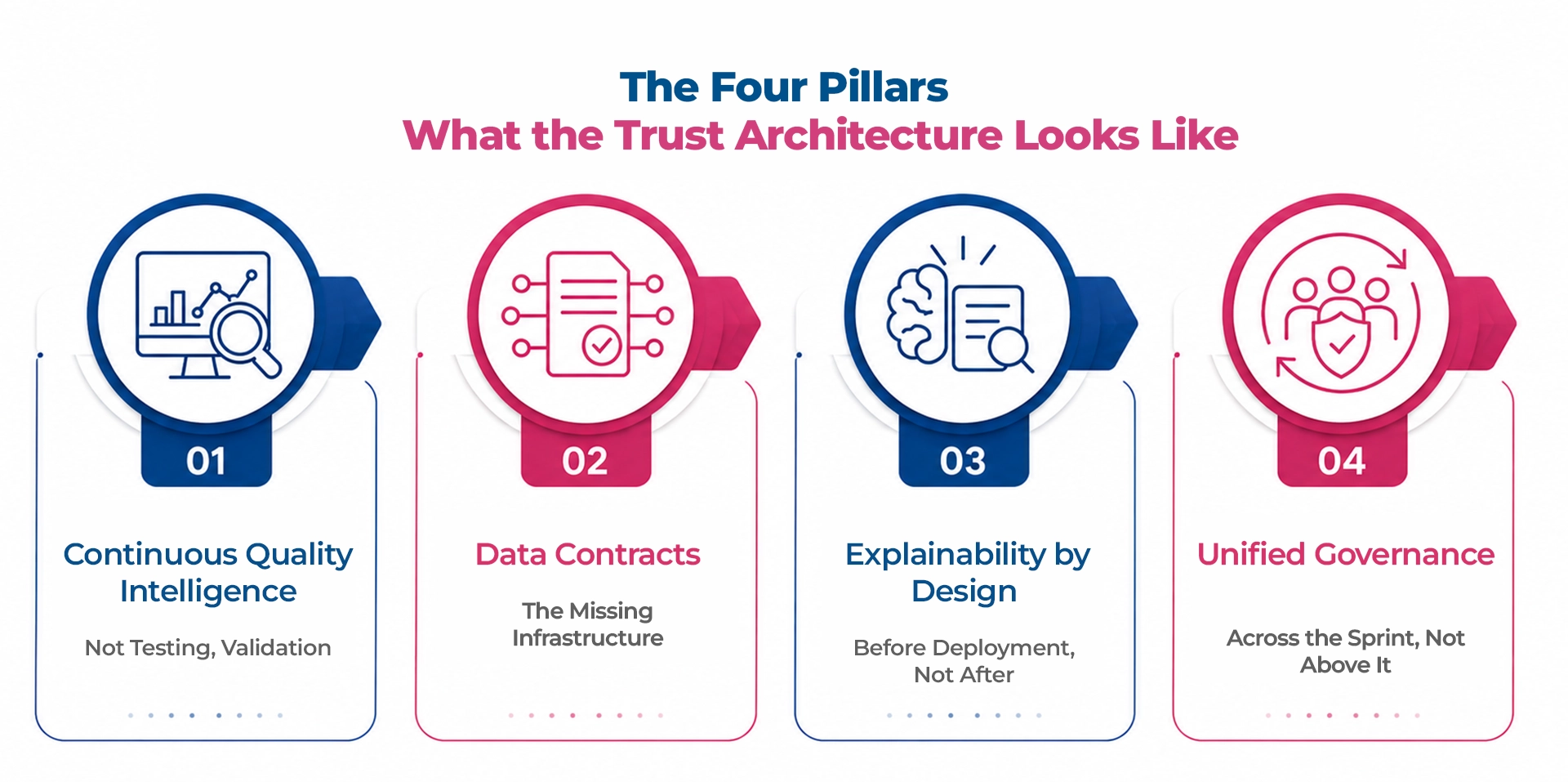
Pillar 1: Continuous Quality Intelligence – Not Testing, Validation
The shift from ‘testing before release’ to ‘validation as a persistent signal’ is the most operationally significant change a delivery organisation can make.
Traditional QA is a gate: code arrives at the gate, tests run, pass/fail is rendered. In AI-first systems, this model breaks down. Model behaviour drifts. Feature distributions shift. Business logic that was correct at training time becomes incorrect at inference time. Gate-based testing will never catch this – because the failure mode is temporal, not structural.
Continuous quality intelligence means embedding monitoring at the model level: tracking prediction confidence distributions, feature value ranges, output class frequencies, and business KPI alignment – in real time, in production. Anomalies surface as signals, not incidents. Teams respond in hours, not weeks.
The practical implication: your CI/CD pipeline for AI systems needs a quality intelligence layer that runs alongside every deployment. Not as an approval step. As a live dashboard that the delivery team owns, monitors, and acts on.
Pillar 2: Data Contracts – The Missing Infrastructure
The phrase ‘data quality’ has been in banking vocabulary for thirty years. It has not solved the problem because it describes a symptom, not a mechanism.
A data contract is a formal, versioned, monitored specification between a data producer and a data consumer. It defines: what schema is expected, what value ranges are valid, what update frequency is required, and what the consequence of violation is. When a contract is breached – a column goes null, a distribution shifts, a latency threshold is crossed – the consuming system is notified before the model makes a decision based on bad data.
Banks deploying models in credit, fraud, and personalisation without data contracts are, in effect, flying instruments without gauges. The plane may be fine. Or it may not be. You will not know until it is not.
BCBS 239 – the Basel Committee’s data aggregation principles – created a regulatory expectation for this in 2013. In 2025, many institutions are still not compliant. AI has not made this less urgent. It has made it existential.
Pillar 3: Explainability by Design – Before Deployment, Not After
The explainability problem in banking AI is misunderstood as a technical challenge. It is not. The techniques exist – SHAP values, LIME, attention mechanisms, decision tracing. The problem is when and how they are applied.
Most organisations treat explainability as a post-deployment requirement: the model is built, deployed, and then someone asks ‘but can you explain it?’ At that point, retrofitting explainability is expensive, imprecise, and often inadequate for regulatory purposes.
Explainability by design means making the decision at model selection time: What type of decisions does this model make? Who can challenge them? Under what regulatory framework? Based on those answers, the explainability architecture is defined before a line of model code is written.
For adverse credit decisions in the US, you need ECOA-compliant adverse action notices – which means you need feature-level attribution for every declined application, not a global feature importance chart. For AML transaction monitoring in the EU, you need model decision tracing that satisfies both internal audit and national competent authority inspection. For generalised AI assistants in customer service, you need output monitoring that can detect hallucination at scale.
These are not the same explainability requirement. The architecture must be segmented by use case – and that segmentation must happen before deployment.
Pillar 4: Unified Governance – Across the Sprint, Not Above It
The governance model that most banks have in place was designed for a different era. Model risk management frameworks like SR 11-7 assume a development-validation-deployment cycle measured in months. Modern AI delivery operates on a cycle measured in weeks or days.
The result: governance frameworks that are structurally unable to keep pace with delivery velocity. Model risk committees that receive approval requests for models that have already been deployed. Compliance teams that review AI systems after incidents, not before deployment.
Unified governance means redesigning the governance model to operate at delivery speed – not by reducing rigour, but by embedding it differently. This means: compliance checkpoints built into sprint definition-of-done criteria. Model risk assessment as a standardised component of the model development lifecycle, not a separate approval track. Engineering, data, and compliance teams sharing a unified risk vocabulary and escalation path.
The question is not: ‘How do we get governance to approve faster?’ It is: ‘How do we embed governance so deeply into delivery that approval is a natural output of a well-executed sprint?’
Who Owns the Trust Layer?
This is the question that determines whether the architecture gets built.
In most banks today, the answer is: nobody, clearly. Engineering owns delivery. Data owns pipelines. Risk owns models. Compliance owns frameworks. Nobody owns the integration of all four into a coherent trust architecture.
The CIO is the only executive with the mandate, the cross-functional authority, and the business context to own this. Not by doing the work – but by setting the expectation that delivery velocity and trust architecture are the same objective, measured together, reported together, and resourced together.
The institutions making this work have, in most cases, created a cross-functional AI execution team – not an AI Centre of Excellence, which tends to produce strategy documents – but an operational team with engineering, data, compliance, and product representation, accountable for the trust metrics of every model in production.
What This Looks Like in Practice
A Tier-1 Asian bank undertook a credit model refresh across its retail lending portfolio in 2023. The previous model had been built with strong predictive accuracy but limited explainability – adequate for the regulatory environment at build time, but exposed by the shift in supervisory expectations around adverse action transparency.
The refresh was designed with explainability as a first-class requirement: SHAP-based feature attribution embedded into the decisioning API, with automated adverse action reason generation mapped to regulatory categories. Data contracts were enforced across the three upstream systems feeding the model. Continuous quality monitoring tracked distribution shift across 11 key features.
Six months post-deployment: zero regulatory findings in model audits. A 34% reduction in customer complaints related to declined applications. And critically – the next model iteration took half the time to deploy because the governance infrastructure was already in place.
Trust architecture is not a cost. It is an investment that compounds
The banks that win the next decade will not be those who deployed AI first.
They will be those who built the infrastructure to trust it – at scale, under examination, in production.
Speed is table stakes. Trust is the moat.
The Next Step
If you are a CIO or CTO working through this challenge – whether you are mid-transformation or building the strategy – the questions worth pressure-testing in your organisation are:
- Do you have data contracts governing the upstream feeds to your AI models in production?
- Can your team explain, at the feature level, why any credit or collections decision was made – within the time window your regulator requires?
- Is your validation infrastructure a gate or a signal?
- Who, by name and role, is accountable for the trust metrics of your top-10 models in production?
If the answers are unclear, the trust layer is not yet built. And every model you deploy between now and when it is built is adding to a debt that will eventually be called.
This blog is part of the series: Engineering Trust in AI-First Banking
Back to Section 3: AI Transformation in Banking – Speed Without Trust Creates Risk
Continue to Section 4: The CIO Mandate – From Digital-First to AI-First Banking
Want to assess your organisation’s trust architecture? Book a conversation with Maveric’s AI Banking Practice
FAQ
1. What are the four pillars of the trust architecture that CIOs need to build in AI-first banking?
The four pillars are:
- Continuous Quality Intelligence (replacing testing as a gate with validation as a persistent signal embedded in the delivery pipeline)
- Data Integrity by Design (enforcing data contracts across all upstream feeds to AI models, so input quality is verified at the point of consumption, not assumed)
- Explainability as a First-Class Requirement (making explainability an architectural decision at model design time, segmented by use case and regulatory obligation, not retrofitted after deployment) and
- Unified Governance Across the Sprint (embedding compliance checkpoints into the delivery cycle itself, so governance operates at delivery speed rather than above it).
2. Why is trust in AI systems fundamentally an architecture problem rather than a governance programme problem?
Because governance frameworks operate downstream of the architecture. When a model produces a biased lending decision, the governance team did not fail – the architecture failed because explainability was not designed in. When stale data corrupts a fraud model’s inputs, the data team did not fail – the architecture failed because data contracts were not enforced. Governance policies, risk committees, and model validation processes cannot compensate for architectural omissions. Trust is not what you add to a system after it is built; it is what you design into it from the start.
3. How does continuous quality intelligence differ from traditional QA testing in AI-first banking?
Traditional QA is a gate: code arrives, tests run, pass or fail is determined, and the release proceeds. In AI-first systems this model breaks down because model behaviour drifts after deployment, feature distributions shift, and business logic that was correct at training time becomes incorrect at inference time. Continuous quality intelligence treats validation as a persistent signal embedded across the full delivery pipeline – detecting distribution shift, monitoring production behaviour against expected baselines, and surfacing anomalies before they affect outcomes rather than after. Institutions that have made this shift report 40 to 60% reductions in production incidents as a direct result.
4. Who should own the trust architecture in a bank, and why does ownership matter so much?
The CIO is the only executive with the mandate, cross-functional authority, and business context to own the trust architecture – not by executing the work, but by establishing that delivery velocity and trust infrastructure are the same objective, measured together and resourced together. In most banks today, engineering owns delivery, data owns pipelines, risk owns models, and compliance owns frameworks – with nobody owning the integration of all four into a coherent trust architecture. That gap in ownership is precisely why the architecture does not get built, and why AI programmes plateau or fail when trusted scale becomes the requirement.
5. What does “explainability by design” mean in practice for a bank with multiple AI models across different regulatory contexts?
It means making the explainability architecture decision at model selection time, not after deployment. The requirement is segmented by use case: adverse credit decisions in the US require ECOA-compliant feature-level attribution for every declined application; AML transaction monitoring in the EU requires model decision tracing that satisfies national competent authority inspection; customer service AI requires output monitoring that detects hallucination at scale. These are not the same requirement, and the architecture must reflect that segmentation from the point of model design – because retrofitting explainability after deployment is expensive, imprecise, and typically inadequate for the regulatory standard it needs to meet.
6. What is the real cost of not building the trust architecture, and how does that cost compound over time?
The absence of trust architecture is a deferred cost with a non-linear growth curve. A loan pricing defect that costs millions in customer remediation had an upstream engineering fix that would have cost days. But the deeper cost is structural: without trust architecture, every additional AI model increases the unmonitored risk surface, every deployment cycle adds to governance debt, and every gap becomes a future remediation event. With trust architecture in place, the dynamic inverts – each validated release builds institutional confidence, each data contract reduces downstream risk, and each explainable decision makes the next regulatory conversation easier. The choice is between complexity that compounds fragility and complexity that compounds confidence.